Barton-McCombie reaction
Abstract
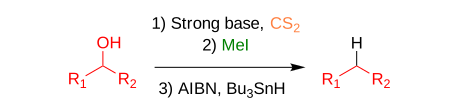
The Barton–McCombie reaction is a reaction that achieves the deoxygenation of a secondary (or primary) alcohol, converting a C–OH bond into a C–H bond via a xanthate ester intermediate and a radical chain mechanism using a tin hydride reductant.
Keywords
Alcohol, Reduction, Alkane
Category
Alcohol
Mechanism
First, the alcohol is deprotonated with a strong base (typically, NaH or BuLi), yielding an alkoxide. The alkoxide subsequently reacts with carbon disulfide (CS2) to give a xanthate anion, which is then methylated with iodomethane (MeI) to provide the corresponding xanthate ester, called Barton-McCombie substrate. It is important to note that the formation of the xanthate anion is difficult for tertiary alcohols due to the steric hindrance. The xanthate ester intermediate is then engaged in a radical deoxygenation using tributyltin hydride (Bu3SnH) and azobisisobutyronitrile (AIBN) that occurs in three steps. First, AIBN decomposes to give isobutyronitrile radicals, which abstracts a hydrogen atom from Bu3SnH to generate the tributyltin radical. This intermediate adds to the electrophilic sulfur of the C=S bond of the xanthate ester, forming a carbon-centered thiocarbonyl radical, stabilized by the adjacent sulfur and oxygen atoms. The radical adducts then undergoes β-scission, expelling the alkyl radical and releasing a tin-containing by-product. Subsequent hydrogen atom transfer from Bu3SnH to the alkyl radical leads to the deoxygenated product.

Recent review
Guo, H. M.; Wu, X. Selective deoxygenative alkylation of alcohols via photocatalytic domino radical fragmentations. Nat. Commun. 2021, 12, 5365.