Amide reduction
Abstract
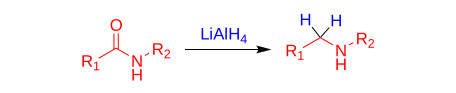
The reduction of an amide to an amine involves formal replacement of the carbonyl oxygen with two hydrogen atoms, converting a C=O into a C–H2 group while retaining the C–N bond. This reaction requires the use of a hydride donor, typically LiAlH4. It is one of the most important methods for C–N bond-forming reductions in synthesis, as amides are readily available from carboxylic acids and amines.
Keywords
Amide, Reduction, Primary amine
Category
Amide
Mechanism
Here, LiAlH4 acts as a hydride donor. The first hydride attacks the electrophilic carbonyl carbon, breaking the C=O bond and transferring the electron pair to the oxygen atom, which becomes an alkoxide coordinated to the metal center. The resulting tetrahedral intermediate then collapses with departure of the aluminium-coordinated oxygen atom, generating an iminium ion intermediate. This intermediate is immediately reduced by a second hydride delivery, breaking the C=N bond and yielding the corresponding amine.
