Alkyne reduction to (E)-Alkene
Abstract
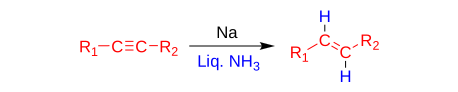
The reduction of an alkyne into a trans (E)-alkene is achieved via dissolving a metal reductant (typically Na or Li), also called Birch-type reduction of alkynes.
Keywords
Alkyne, Reduction, (E)-Alkene
Category
Alkyne
Mechanism
The reaction proceeds via two successive single-electron transfer (SET) steps. First, an electron from the dissolved alkali metal (here, Na) is transferred to one carbon atom of the alkyne, generating a radical anion. Then, the radical anion is protonated by ammonia (NH3), giving a vinyl radical. This radical adopts the more stable trans geometry (the two substituents prefer to be on opposite sides to minimize steric strain). A second electron is then donated to the vinyl radical, generating a vinyl carbanion (also trans-configured). Finally, the vinyl carbanion is protonated by another molecule of ammonia, yielding the final (E)-alkene.
