Alkyne oxymercuration
Abstract
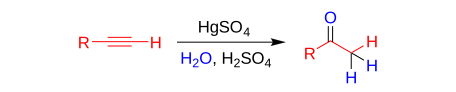
Alkyne oxymercuration is a reaction that converts an alkyne into a carbonyl compound through the addition of water across the carbon-carbon triple bond. The reaction is carried out under acidic conditions using a mercury(II) catalyst, typically HgSO4 in aqueous sulfuric acid, and proceeds with Markovnikov regioselectivity.
Keywords
Alkyne, Markovnikov, Enol, Ketone
Category
Alkyne
Mechanism
Mechanistically, the alkyne is first activated by coordination to the mercury(II) ion, which increases the electrophilicity of the triple bond. Water then attacks the more substituted carbon atom of the activated alkyne, leading to the formation of a vinyl mercury intermediate. Subsequent deprotonation and protonolysis regenerate the mercury catalyst and yield an enol intermediate that tautomerizes to form the corresponding ketone.
