Alkyne hydroboration (Anti-Markovnikov)
Abstract
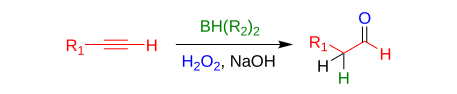
Hydroboration of alkynes is a two-step reaction that converts an alkyne into a carbonyl compound through anti-Markovnikov addition of water across the carbon-carbon triple bond. The reaction is typically carried out using a bulky borane reagent, such as disiamylborane (Sia2BH) or 9-BBN, followed by oxidation with hydrogen peroxide (H2O2) in basic medium.
Keywords
Alkyne, Anti-Markovnikov, Enol, Ketone, Aldehyde
Category
Alkyne
Mechanism
First, the alkyne reacts with the bulky borane through a concerted four-center transition state. The B-H bond adds across the triple bond in a syn fashion, with both boron and hydrogen being delivered to the same face of the alkyne. Because boron is sterically bulky, it preferentially bonds to the less substituted carbon atom, while hydrogen is transferred to the more substituted carbon atom. This regioselectivity results in the anti-Markovnikov placement of boron. The resulting vinylborane intermediate is then oxidized with hydrogen peroxide under basic conditions. Hydroperoxide anion (HO2-) attacks the boron center, generating a peroxyborate intermediate. A subsequent 1,2-vinyl migration from boron to oxygen occurs, replacing the C-B bond with a C-O bond and yielding an enol. The latter is generally unstable and rapidly undergoes keto-enol tautomerization to give the corresponding carbonyl compound.
Overall, hydroboration provides a valuable complementary method to acid-catalyzed hydration, as it converts terminal alkynes into aldehydes through anti-Markovnikov hydration while avoiding carbocationic intermediates and rearrangements.
