Aldol reaction
Abstract
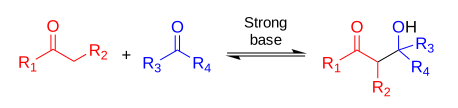
The aldol reaction is a carbon-carbon bond forming reaction in which two carbonyl compounds (aldehydes, ketones or one of each) react in the presence of a strong base (B) such as sodium hydroxide to form a β-hydroxy carbonyl compound also known as aldol.
Keywords
Aldehyde, Ketone, C-C bond formation, β-hydroxy carbonyl
Category
Aldehyde/Ketone
Mechanism
First, the base deprotonates one of the carbonyl compounds at the α-position relative to the carbonyl group to generate an enolate intermediate. This enolate then attacks the other carbonyl compound, affording a tetrahedral alkoxide intermediate. Subsequent protonation of this intermediate by water yields the β-hydroxy carbonyl compound.
