Alcohol tosylation
Abstract
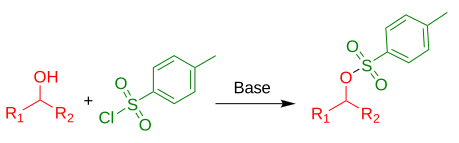
Tosylation is a reaction in which the hydroxyl group of an alcohol is converted into a tosylate (OTs), by reaction with tosyl chloride (TsCl, 4-methylbenzenesulfonyl chloride) in the presence of a base, typically pyridine or triethylamine.
Keywords
Alcohol, Tosyl chloride, Tosylate ester
Category
Alcohol
Mechanism
The reaction proceeds in two steps. First, the oxygen atom of the hydroxyl group attacks the electrophilic sulfur atom of the tosyl chloride, displacing a chloride ion and forming a protonated tosylate intermediate. Then, the base deprotonates this intermediate, yielding the final tosylate ester product. It is important to note that the tosylate ester is an excellent leaving group, which makes it very useful for subsequent nucleophilic substitution reactions.
